
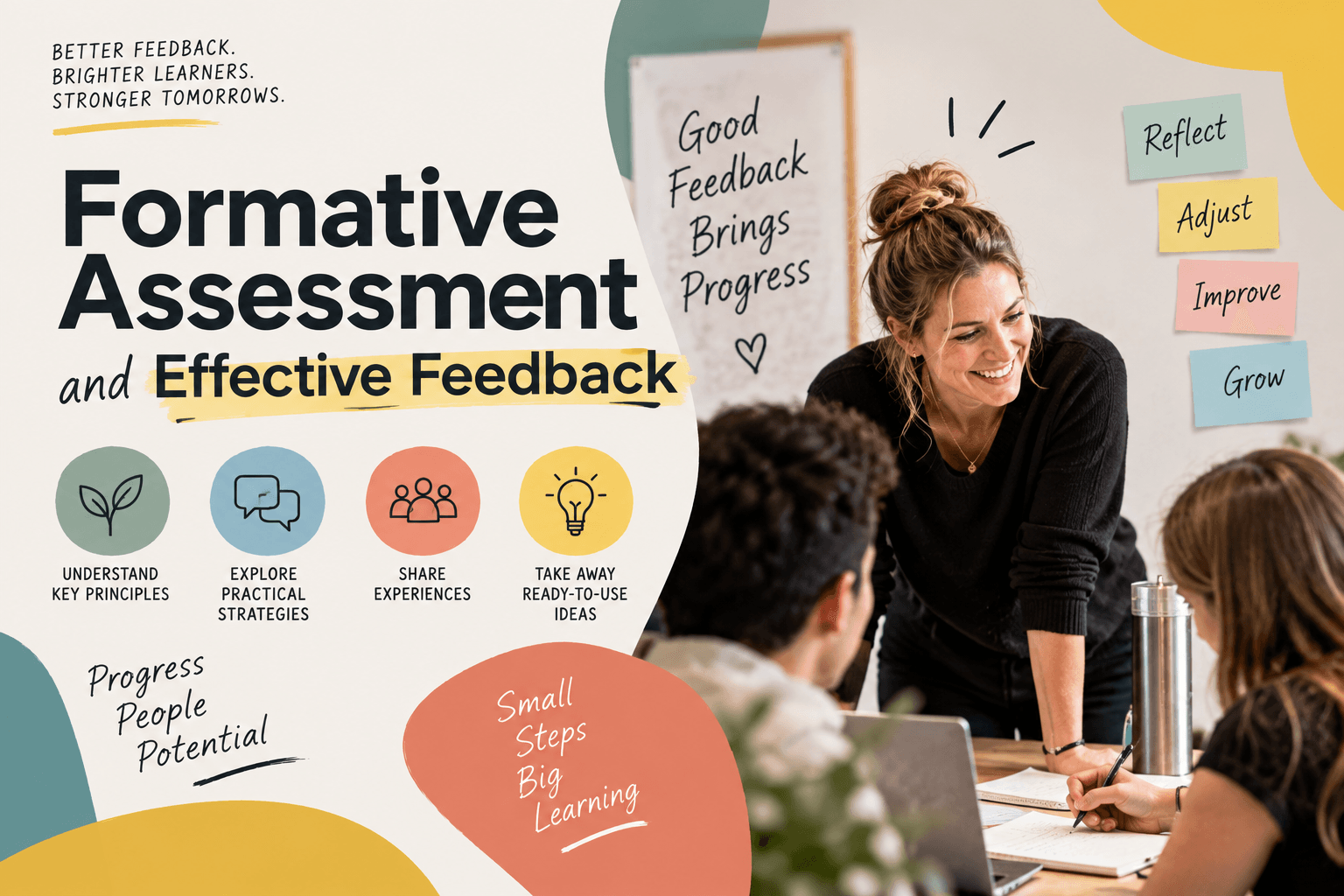
Formative Assessment and Effective Feedback
Make assessment work for learning: feedback, self-assessment and smarter grading.
Course description
Assessment shapes what students learn and how they feel about school. This course focuses on formative assessment: gathering evidence during learning and using it to adapt teaching. You will practise techniques such as questioning strategies, exit tickets, success criteria, peer and self-assessment and feedback that students actually use. We also look at digital assessment tools, at reducing teacher workload and at aligning formative practice with national grading requirements. Participants analyse their own assessment tasks and redesign one of them during the week. Suitable for teachers of all subjects and levels, and for school leaders responsible for assessment policy.
Learning objective
Participants will be able to design success criteria and formative checkpoints for a unit, give feedback that moves learning forward, use peer and self-assessment routines, and select digital tools for quick evidence gathering, while keeping their workload sustainable.
Teaching methods and assessment
Methods: workshops, analysis of real student work and assessment tasks, modelling of techniques by trainers, digital tool try-outs, redesign of a participant's own assessment task. Assessment: peer review of the redesigned task using shared criteria, daily quick checks (the techniques we teach), final presentation and self-assessment.
Materials and learning resources
Course handbook, technique cards, rubric and success-criteria templates, sample student work, access to digital tools (Socrative, Wooclap, Google Forms), reading list. Participants bring one of their own assessment tasks.
Course package
25 hours of training, course materials, certificate of attendance, Europass Mobility and Learning Agreement support, welcome get-together, guided walking tour of Florence, coffee breaks, pre-departure info pack.
Course programme
Why formative assessment?
Welcome and participant presentations. The evidence base for formative assessment. Mapping current assessment practice in participants' schools. Learning intentions and success criteria.
Gathering evidence in every lesson
Questioning strategies, hinge questions, exit tickets and mini-whiteboards. Digital quick checks. Practising techniques in simulated lessons.
Feedback that students use
Characteristics of effective feedback. Comment-only marking, feedback conversations, whole-class feedback. Workload-friendly routines. Analysing samples of feedback.
Peer and self-assessment
Training students to assess. Rubrics and single-point rubrics. Portfolio approaches. Redesigning the participant's own assessment task with peer support.
Presentation and transfer
Presentation of redesigned tasks, peer review and final feedback. Planning implementation at school, Erasmus+ documentation and evaluation. Certificate ceremony.
Course locations
Reviews
No reviews yet.
Your review
Please log in to review this course after attending.